
TMV testing across the UK
TMV Servicing Specialists arranges in-service TMV testing for landlords and premises managers across the UK. A partner engineer measures what each valve is actually delivering, isolates the cold supply to prove the fail-safe, and records the results against the set point. It is evidence-gathering, not maintenance, so you know where every valve stands.
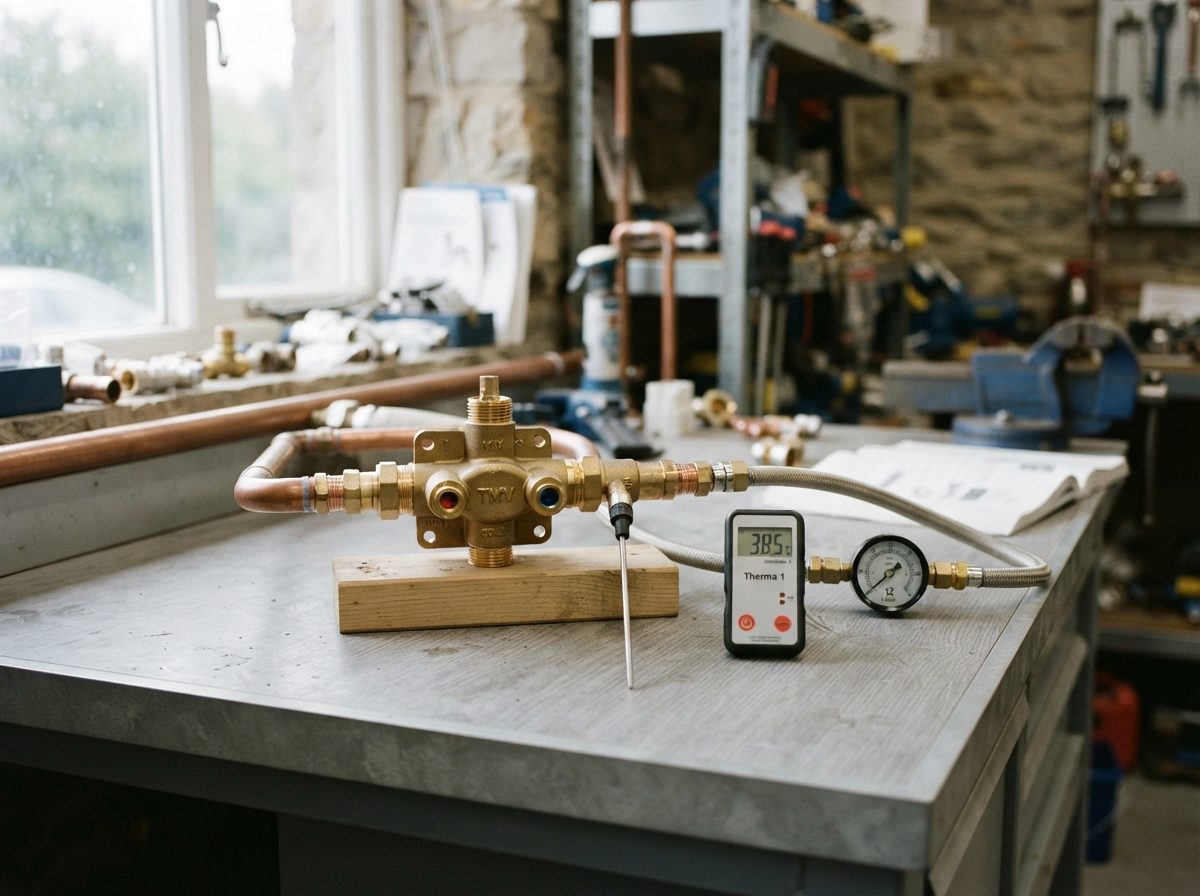
Testing that tells you how each valve is performing
TMV testing is a measurement job. The engineer does not strip or clean the valve; they find out whether it is doing what it should. That means a temperature at the outlet with the tap running fully open, the hot and cold supply temperatures feeding it, a fail-safe test with the cold supply isolated and a check that the temperature recovers once the cold comes back. Each figure is written down against the valve's set point, so a reading of 43°C means something when the agreed figure is 41°C.
It is aimed at people who must show that valves are being looked after: landlords with TMVs on baths in rented homes and HMOs, facilities and premises managers in schools, offices and leisure buildings, and estates teams in care and healthcare who follow the in-service test regime in HTM 04-01 and its D 08 supplement. In healthcare the first tests fall about 6-8 weeks and 12-15 weeks after commissioning, with later intervals set by how much each valve has drifted.
Testing alone is the right choice when your valves are known to be in reasonable order and what you need is a dated, valve-by-valve set of results. Where test results already show drift, poor recovery or a failed fail-safe, the follow-on work is a full service, fault finding or repair. If nobody has ever set a baseline for the valves, commissioning should come first so that later tests have something to be compared with.
What a TMV test records
For each valve, a test visit normally captures the following.
- Outlet temperature at full flowThe mixed water is measured at the outlet with the tap or shower fully open, once the reading has stabilised.
- Hot and cold supply temperaturesSupply readings show whether the conditions feeding the valve are normal. A test result means little if the hot supply was low that day.
- Comparison with the set pointEach outlet reading is set against the temperature agreed for that outlet, and the difference noted.
- Fail-safe testThe cold supply to the valve is isolated. The flow should stop or fall to a trickle within a few seconds. Anything more is recorded as a fail.
- Recovery readingWhen the cold supply is restored, the mixed temperature should return close to its earlier reading, commonly within 2°C.
- Observations at the outletThings that affect safety or testing, such as a missing isolator, a leaking union or a valve that cannot be reached, are noted.
- Pass, fail and follow-upEach valve is marked against the results, and any that need further work are listed so you can act on them.
What to have ready for testing
-
Agreed set points
The test needs a figure to measure against. If you do not have set points for each outlet, decide them with your risk assessment before the visit.
-
The previous results
Earlier readings let the engineer show drift since the last test, which is what decides the next interval under HTM 04-01.
-
Isolation valves that work
The fail-safe test depends on being able to isolate the cold supply to the valve. Seized isolators make this difficult or impossible.
-
Access to tenanted or occupied rooms
Landlords need to give tenants proper notice. In care settings, testing is planned around residents' bathing routines.
Good to know about TMV testing
-
A test is a snapshot
Results show how the valve performed on the day, under the supply conditions on the day. That is why supply temperatures are recorded alongside the outlet reading.
-
No law sets a test frequency
Health and safety law requires those in control of premises to manage the risk, and the risk assessment sets how often TMVs are tested. HTM 04-01 gives a structured regime for healthcare.
-
Inspectors look for records
Care regulators and housing inspectors look for evidence that hot water risks are managed. A dated record per valve is the clearest form of that evidence.
-
A failed test needs action
A valve that fails its fail-safe or reads well above its set point is a scald risk. The outlet should be taken out of use or made safe until it is put right.
How TMV testing is arranged
- 1
Enquire online
Fill in the enquiry form with the address, the number of valves and whether you hold earlier results or set points.
- 2
Matching an engineer
Alex matches the testing to a partner engineer who works in your area and can fit around your access arrangements.
- 3
Agreeing the price
The price is based on the number of valves and the access involved, and we confirm it before work starts.
- 4
Test visit
The engineer tests each valve in turn: outlet and supply readings, fail-safe and recovery.
- 5
Results in writing
A visit usually leaves you with a result per valve against its set point, the fail-safe outcome and a list of valves needing further work.
TMV testing questions
What is the difference between testing and servicing?
Testing measures and records how each valve performs. Servicing adds work on the valve, such as cleaning strainers and adjusting the setting.
How often should TMVs be tested?
Your risk assessment sets it. In healthcare, HTM 04-01 sets tests at about 6-8 and 12-15 weeks after commissioning, then at an interval based on drift.
Do landlords have to test TMVs?
No regulation names TMV testing for landlords, but landlords must manage hazards such as scalding. Testing and keeping records is a straightforward way to show that.
What counts as a pass on the fail-safe test?
With the cold supply isolated, the flow should stop or reduce to a trickle. On restoring the cold, the temperature should come back close to its earlier reading.
Will the engineer adjust a valve that is reading high?
The test records the result. A small adjustment can be agreed on the day, but a valve that needs more is listed for servicing or repair.
Can every valve be fail-safe tested?
Only where the cold supply can be isolated. Valves without accessible isolators are recorded as not tested, with a note on why.
Does testing cover thermostatic showers and taps?
Yes, where the valve is thermostatic. The same readings and fail-safe check apply, adapted to how the shower or tap is built.
Services that follow on from testing
- TMV fault findingDiagnosis for valves that fail a test, read too hot or cold, or swing in temperature.
- TMV commissioningThe baseline readings later tests are compared against, for new or rebuilt valves.
- TMV asset registersA list of every valve, its location and set point, so testing covers the whole site.
- Landlords and HMOsHow TMV testing fits around tenanted homes and shared houses.
Arrange TMV testing
Send an enquiry with the number of valves and any earlier results. Alex will match the job to a partner engineer and confirm the price before work starts.
Send an enquiry