
Blending valve servicing
TMV Servicing Specialists services blending valves, the larger group mixing valves that feed several outlets at once, across the UK. They are common in school changing rooms, sports and leisure shower blocks and older washrooms. A partner engineer services and tests the valve and looks at the mixed-water pipework it feeds.
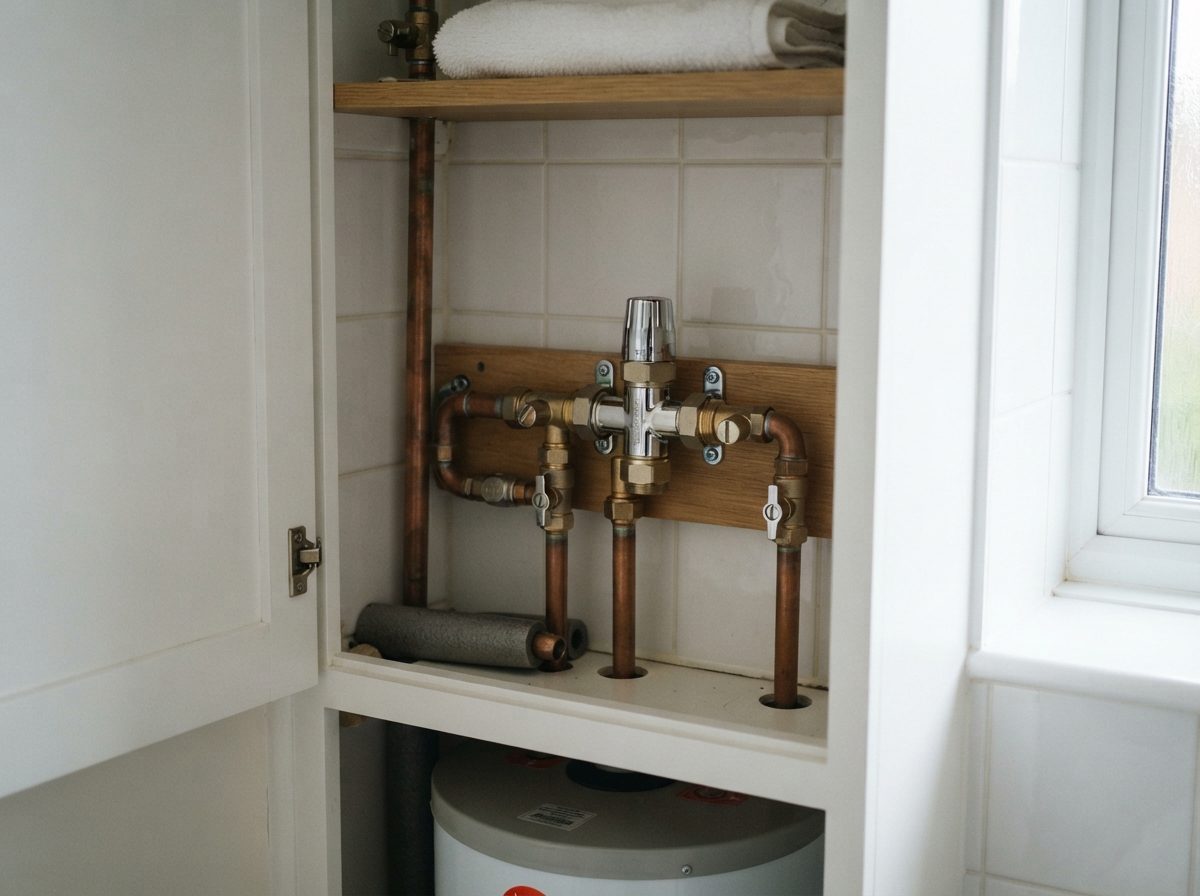
Blending valves: one valve, many outlets
A blending valve, also called a group or master mixing valve, is a large thermostatic valve that mixes hot and cold water once and sends the blended water to a whole row of showers, basins or troughs. You typically find one in a plant room or beside the boiler or calorifier, feeding a pipework run out to a school changing room, a sports pavilion, a gym shower block, a factory washroom or a campsite toilet block. It does the job of many point-of-use TMVs with one body, which made it popular for cost and simplicity.
The drawback is the pipework downstream. Water leaving the valve sits between 35°C and 45°C, well inside the range where Legionella bacteria can multiply, and in a blending valve system it may travel a long way and stand still for hours between uses. HSG274 Part 2 advises keeping mixed-water runs as short as possible, and where a single valve serves outlets some distance away, the Legionella risk assessment often points to point-of-use TMVs at each outlet or a regime of temperature control and flushing that suits the system.
This service is for existing blending valves that need servicing, testing or repair, and for sites deciding whether to keep them. If the outlets each have their own small TMV, standard TMV servicing applies. Where the question is whether to swap a blending valve for individual valves, TMV replacement or a survey will help set out the options.
Blending valve servicing includes
Group mixing valves are bigger and work harder than point-of-use valves. A service normally takes in:
- Supply temperatures at the valveMeasuring the hot supply from the boiler or calorifier and the cold supply, since stored hot water should be held at about 60°C.
- Mixed outlet temperatureMeasuring the blended temperature leaving the valve and at the nearest and furthest outlets, to show how much heat is lost along the run.
- Response under demandRunning several outlets at once and then one at a time, to see whether the valve holds temperature as demand changes.
- Strainers and check valvesCleaning the larger inlet strainers and checking the check valves, which collect scale and debris from the whole system.
- Thermostatic elementInspecting, descaling or replacing the element or cartridge, and checking the valve body for wear.
- Fail-safe testIsolating the cold supply and checking the valve shuts off or reduces flow, then restoring it and checking recovery.
- Pipework and dead legsNoting long mixed runs, unused branches, removed outlets left as dead legs and any lack of insulation.
- Findings and optionsRecording results and setting out whether the valve can stay in service or whether point-of-use TMVs would be safer.
Things to plan
-
When the outlets can be off
Every outlet fed by the valve loses warm water during the service, so pick a time when the changing rooms or washrooms are out of use.
-
Where the valve is
Plant rooms, boiler houses and ceiling voids all need access arranged and keys available.
-
Your Legionella risk assessment
Share it, along with flushing and temperature records, so the engineer's findings fit what the assessor has already said.
-
Pipework drawings
Any drawing showing which outlets the valve feeds helps identify dead legs and the furthest outlet.
What to know about blending valves
-
When point-of-use TMVs are preferred
Where vulnerable people use the outlets, where runs are long or use is irregular, individual TMVs close to each outlet are usually the better control. D 08 and healthcare guidance favour valves at or near the outlet.
-
School and sports use is irregular
Shower blocks may sit unused over holidays, closed seasons or weekends. Flushing before reopening, and routinely for little-used outlets, matters more with a long mixed run.
-
One fault affects every outlet
A failed blending valve can send water too hot or too cold to all the showers it feeds, so its fail-safe test and supply temperatures deserve close attention.
-
Test the furthest outlet too
Readings only at the valve can hide heat loss. Comparing the furthest outlet shows how the run behaves in practice.
How a blending valve job runs
- 1
Enquiry
Tell us what the valve feeds, where it is and whether you have a recent Legionella risk assessment.
- 2
Alex matches the job
The work is passed to a partner engineer covering your area who works on larger mixing valves.
- 3
Scope and price confirmed
The price depends on valve size, access, the number of outlets to test and any parts; it is agreed before work starts.
- 4
Service and system checks
The engineer services the valve, tests it and checks outlets along the run.
- 5
Report and recommendations
You should expect readings at the valve and outlets, the fail-safe result and advice on whether the arrangement should change.
Blending valve questions
What is the difference between a blending valve and a TMV?
Both mix hot and cold thermostatically. A point-of-use TMV serves one outlet or a few close by; a blending valve serves a group of outlets through longer pipework.
Are blending valves still allowed?
Yes, but the Legionella risk assessment must show the mixed-water system is controlled, and in many settings point-of-use valves are preferred.
Why does the end shower run cooler?
Heat is lost along the mixed-water pipe, especially if it is uninsulated or the water has been standing. That is also a sign of conditions bacteria like.
Can a blending valve be replaced with individual TMVs?
Usually, by running hot and cold to each outlet area and fitting a valve close to each. It is a bigger job and is normally planned after a survey.
How often should a blending valve be serviced?
The risk assessment and written scheme set it. Because one valve controls many outlets, they are often checked at least as often as point-of-use valves.
Do we need to flush the showers it feeds?
Little-used outlets should be flushed, commonly weekly, and recorded, and a shower block should be flushed before it reopens after a closed period.
Related services and guides
Have a blending valve feeding a shower block or washroom?
Tell us what it feeds, where it sits and what records you hold. Alex will arrange a partner engineer and agree the price with you before the visit.
Send an enquiry