
How often should TMVs be tested?
There is no single fixed interval for testing a thermostatic mixing valve. The healthcare approach starts with tests soon after commissioning and then sets each valve's interval by how much it has drifted. This guide explains that pattern, how strainers and water hardness come into it, and who decides the interval on a particular site.
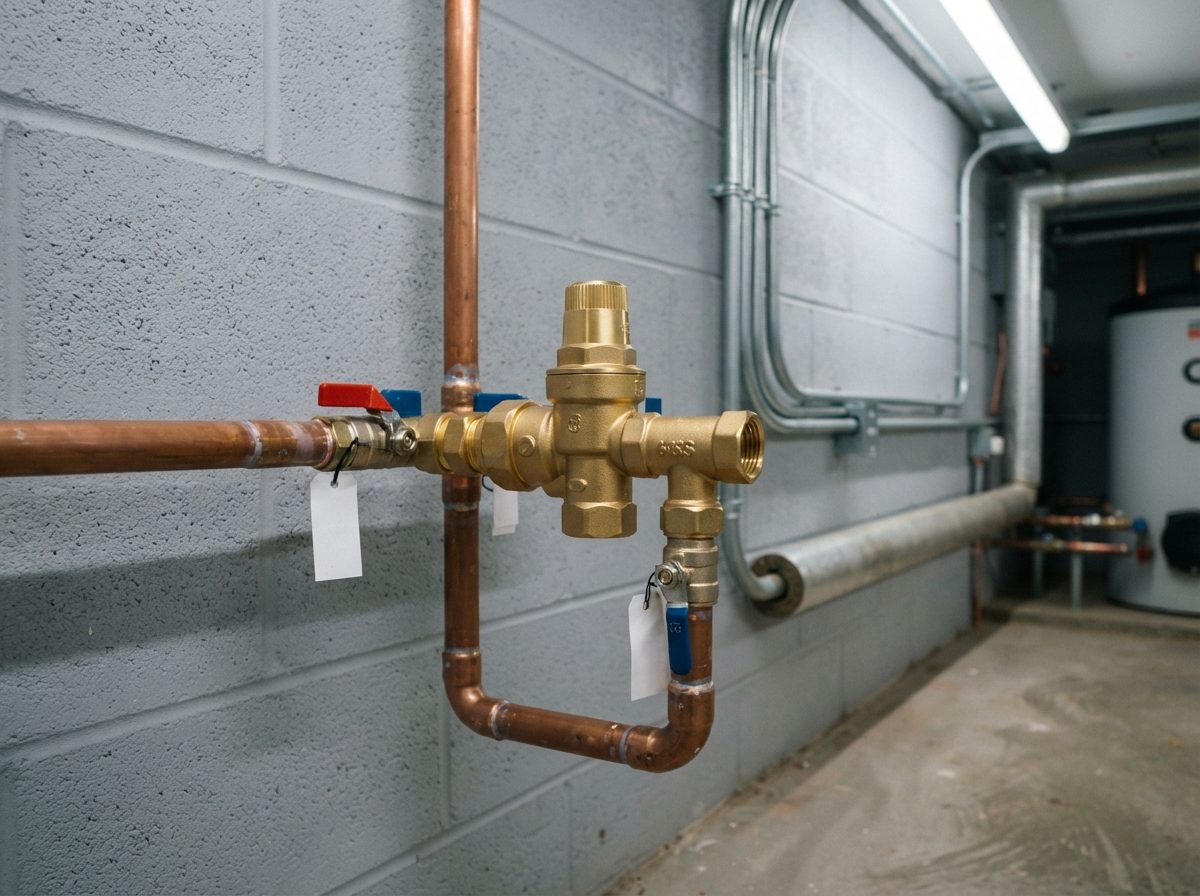
The principle: test, measure drift, then set the interval
Every TMV drifts a little over time as scale forms and parts wear. Some hold their setting for months; others move noticeably within weeks, depending on the valve, the water and how much it is used. Rather than pick one interval for every valve, the D 08 guidance used in healthcare asks for early tests to see how each valve behaves, and then sets the next interval based on that evidence.
This makes testing proportionate. Valves that are stable are tested less often, and valves that drift get more attention. It also builds up a record for every valve, which is useful in its own right when a regulator, insurer or auditor asks how the risk is being controlled.
The usual sequence
The stages below follow the D 08 approach. Read them as a timeline from installation.
-
Commissioning
When the valve is installed or replaced, the mixed temperature is set for the outlet, the fail-safe is tested by isolating the cold supply, and the baseline readings are recorded: mixed temperature, hot and cold supply temperatures and the result of the fail-safe check.
-
First in-service test: about 6 to 8 weeks
The valve is tested again under the same conditions. The new mixed temperature is compared with the commissioning figure, and the fail-safe is repeated.
-
Second in-service test: about 12 to 15 weeks
A further test gives a second measure of how much the valve has moved since commissioning.
-
Setting the routine interval
Using the change measured across those tests, the next interval is chosen. A valve that holds within about 1°C can typically go about 24 to 28 weeks between tests. A valve that has drifted more is given a shorter interval.
-
Ongoing tests
Each later test is compared with the commissioning baseline. If a valve starts to drift more, its interval is shortened; if it stays stable, the interval can stay as it is.
How Annex F works in practice
Annex F of D 08 links the size of the temperature change to the length of the next interval. The smaller the change, the longer the gap. If a valve fails its fail-safe test or its mixed temperature has moved beyond the acceptable range, it is serviced, reset and treated as newly commissioned, so the early test pattern starts again.
Some sites group valves of the same type, age and water supply and apply a common interval, as long as the records support it. Others set an interval valve by valve. Either way, the decision should be written down with the reasoning behind it, so the next person can see why a valve is on a 12-week cycle and its neighbour on 26 weeks.
Strainers, servicing and hard water
-
Strainers at least once a year
The fine mesh strainers on each inlet catch grit, scale and debris. They are commonly cleaned and checked annually, or more often where the risk assessment or the condition of the water says so.
-
Full servicing
A full service usually involves cleaning or replacing the cartridge, checking or renewing check valves and seals, and recommissioning. It is often done when tests show drift or a failed fail-safe, or on a planned cycle.
-
Hard water areas
London, the South East, the East of England, much of the Midlands and the Bristol and Bath area have hard water. Scale builds up on shuttles, elements and strainers faster there, so valves tend to drift sooner and intervals are often shorter.
-
Soft water areas
Scotland, Wales, the North West, much of the North East, Devon and Cornwall and Birmingham's Elan Valley supply have softer water. Scale is less of an issue, but strainers still collect debris and sediment, especially after mains work.
-
Little-used outlets
Valves that rarely run can stick or collect sediment. They may need checking more often, and they also need flushing for Legionella control.
Who sets the interval?
On most non-domestic sites, the interval is set through the risk assessment and the written scheme for the water system, under the person responsible for water safety. The scheme should name the valves, their set temperatures, the test method and the interval, and say what happens when a valve fails.
In homes, the manufacturer's instructions are the main guide, usually with a recommendation for periodic servicing. Landlords and housing providers often build TMV checks into their wider safety inspections. Where nobody has set an interval, starting with the commissioning and early tests described above gives evidence for a sensible routine rather than a guess.
Questions about test intervals
Is there a legal maximum interval between TMV tests?
No law sets one. The interval comes from the risk assessment and written scheme, and healthcare guidance gives a method for setting it.
Can I just test every TMV once a year?
Some low-risk sites do, if the risk assessment supports it. In care and healthcare settings, the D 08 approach based on measured drift is the usual benchmark, and many valves need testing more often than yearly.
What counts as too much drift?
As a rough guide, a valve that holds within about 1°C is stable. Larger changes lead to shorter intervals, and a valve outside its acceptable range is serviced and recommissioned.
Does replacing a cartridge restart the sequence?
Yes. After a cartridge change or major service the valve is recommissioned, and the early tests are repeated to see how it now behaves.
Why are my valves drifting so quickly?
Hard water, debris in the supply, unbalanced pressures, worn parts or a valve that does not suit the pressure are common causes. Test records help narrow it down.
Do thermostatic taps follow the same routine?
The same principles apply. The test is made at the tap outlet, and the manufacturer's instructions describe how to access the cartridge and strainers.
Related services
Want a testing routine set up?
Send an enquiry with the number of valves, the site type and any existing records. We will match the job to a partner engineer and confirm the price before work starts.
Send an enquiry