
What is a thermostatic mixing valve?
A thermostatic mixing valve, or TMV, takes hot and cold water and blends them to a fixed, safe temperature before the water reaches a tap, shower or bath. This guide explains how the valve does that, what happens when a supply fails, where TMVs are normally fitted, how they differ from thermostatic taps and blending valves, and why they need regular attention.
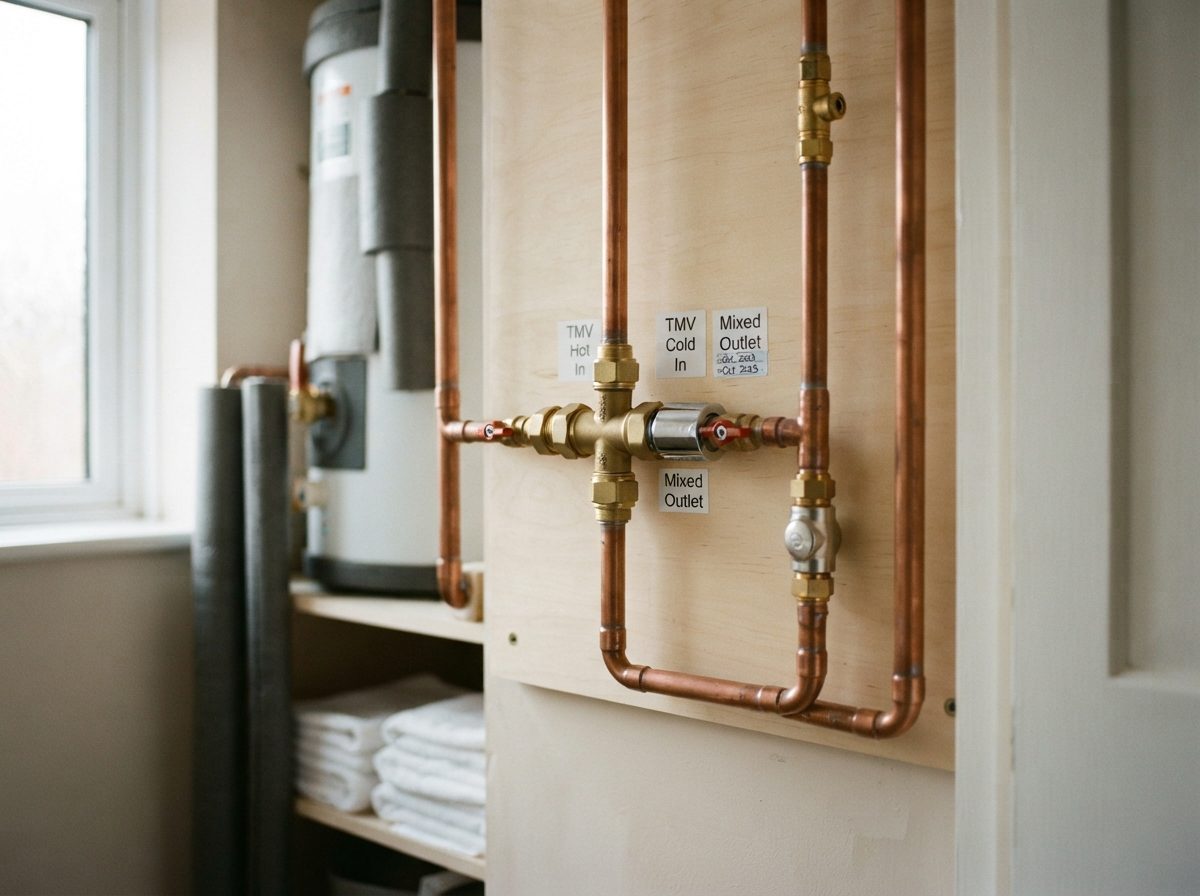
What a TMV does
Hot water in a building is usually stored or delivered at a temperature high enough to control Legionella bacteria, commonly around 60°C at the cylinder, but water that hot can scald in seconds. A TMV deals with both risks at once: the pipework upstream stays hot enough to keep bacteria in check, while the water that comes out of the outlet is held at a temperature that is comfortable and much less likely to cause a scald.
Unlike a simple mixer tap, which only mixes whatever proportion of hot and cold the user selects, a TMV keeps correcting itself. If someone flushes a toilet and the cold pressure drops, or the boiler output rises, the valve senses the change in the mixed water and adjusts the hot and cold proportions to bring the outlet back to its set point.
How the thermostatic element and cartridge work
Most TMVs sold in the UK use the same basic arrangement inside the body, even though the shapes and sizes vary between makes.
-
The thermostatic element
At the heart of the valve is a small sealed capsule, usually filled with a wax compound. Wax expands as it warms and contracts as it cools, and that movement is used to push a piston.
-
The shuttle
The element moves a sleeve or shuttle that sits between the hot and cold inlet ports. As the mixed water gets hotter, the element expands and the shuttle closes down the hot port while opening the cold. As it cools, the opposite happens. The valve settles where the blend matches the set temperature.
-
The cartridge
In many valves the element, shuttle, spring and seals come together as a replaceable cartridge. That makes servicing simpler, because a worn or scaled cartridge can be cleaned or swapped without removing the whole valve body from the pipework.
-
Temperature adjustment
The set point is changed by a spindle or screw that alters where the element sits. On most valves for public or care settings this adjustment is hidden under a cap or needs a special tool, so users cannot turn the temperature up.
-
Strainers and check valves
Each inlet normally has a fine mesh strainer to catch debris and a non-return (check) valve to stop hot water creeping into the cold supply, or the reverse. Both are small parts that make a large difference to how well the valve performs.
-
Isolating valves
Good installations include isolating valves on the hot and cold feeds, so the TMV can be tested, serviced or removed without draining the system.
What fail-safe means
A TMV is designed to fail safe. If the cold supply is lost, the element senses the sudden rise in temperature and drives the shuttle to close the hot port, so the flow stops or drops to a trickle instead of sending full-temperature hot water to the outlet. Valves tested for higher-risk settings are also expected to shut down or restrict flow if the hot supply fails, so a user is not hit with cold water either.
This behaviour depends on the valve being clean, correctly set and in good condition. Scale on the shuttle, a sticking element or a failed check valve can slow the response or stop the shut-off working properly. That is why a fail-safe check, made by isolating the cold supply under controlled conditions, forms part of commissioning and routine testing.
Where TMVs are usually fitted
-
Care homes and hospitals
Baths, showers and washbasins used by residents and patients, where the people using the water may not be able to react quickly to a sudden rise in temperature.
-
Schools and nurseries
Washbasins in toilets and changing areas, and showers in sports facilities, where children use the outlets unsupervised.
-
Housing
Baths in new homes, homes for older people, supported housing, social housing and houses in multiple occupation, often fitted to meet building regulations or because a risk assessment calls for them.
-
Hotels, gyms and leisure centres
Showers and washbasins used by the public, where the owner has no idea who will turn the tap on next.
-
Offices and commercial washrooms
Hand-wash basins, particularly where the hot supply comes from a high-temperature water heater.
TMV, thermostatic tap or blending valve?
These names are sometimes used loosely, so it helps to know what each one usually means.
-
Standalone TMV
A separate valve body fitted in the pipework, often under a basin, behind a panel or in a duct, supplying one outlet or a small group. Mixed water then travels along a short pipe to the tap or shower.
-
Thermostatic tap
A tap with the thermostatic mechanism built into its body, so there is no separate valve and almost no mixed-water pipe. This suits basins where a short dead leg matters, but servicing means working on the tap itself.
-
Thermostatic shower valve
A shower control with a thermostatic cartridge inside. Some are tested to the same scheme standards as standalone TMVs; others are domestic shower mixers with a temperature stop and are not a substitute where a TMV is required.
-
Blending valve
A term often used for a thermostatic valve that feeds several outlets, such as a row of washbasins. Some are tested as TMVs; others are tempering valves meant to control distribution temperature rather than to protect users at the outlet. Check what the valve is approved for before relying on it.
Why TMVs need servicing
A TMV is a mechanical device working with moving parts in water every day. Over time, scale builds up on the shuttle and element, strainers collect grit and sediment, seals harden and check valves wear. The result is usually gradual drift: the mixed temperature creeps up or down, the valve responds more slowly to changes in supply, or the fail-safe shut-off becomes unreliable.
Regular testing shows whether a valve is still doing its job, and servicing puts right the things that make it drift. Healthcare guidance sets out a pattern of in-service tests after commissioning, with later intervals based on how much each valve has changed. Outside healthcare, the interval is normally set by the site's risk assessment, guided by the manufacturer and by how hard the local water is. Our guide to TMV testing intervals covers this in more detail.
Common questions about TMVs
Does a TMV make the water too cool to kill Legionella?
The TMV only lowers the temperature after the valve. The hot pipework feeding it should still be kept hot enough to control bacteria, and the mixed-water pipe after the valve should be as short as possible.
Can I adjust the temperature of a TMV myself?
The set point can be changed, but on most valves it is deliberately tamper-resistant. Any change should be checked with a thermometer at the outlet and recorded, and in care or healthcare settings it should follow the site's procedures.
How long does a TMV last?
It depends on the valve, the water quality and how well it is looked after. Cartridges and check valves are often replaced during the life of a valve, and a body that can no longer hold its temperature or pass a fail-safe test is usually replaced.
Do all homes need TMVs?
Not all. Building regulations limit bath water temperature in new homes, which is often achieved with a TMV, and a risk assessment may call for them elsewhere, for example where a vulnerable person lives.
Related services
- TMV servicingRoutine servicing to keep a valve holding its set temperature and passing its fail-safe test.
- TMV testingTemperature and fail-safe checks with the results recorded for each valve.
- Thermostatic tapsWork on taps with the thermostatic mechanism built into the body.
- Blending valvesValves feeding groups of outlets, such as rows of washbasins.
Need work on a TMV?
Use the enquiry form to tell us what valves you have and where they are. We will match the job to a partner engineer and confirm the price before any work starts.
Send an enquiry