
TMV servicing in England
TMV Servicing Specialists arranges thermostatic mixing valve servicing, testing, repair and installation in England, from Cornwall to Northumberland. A partner engineer near the site does the work, and the guidance they work to is the English set described below.
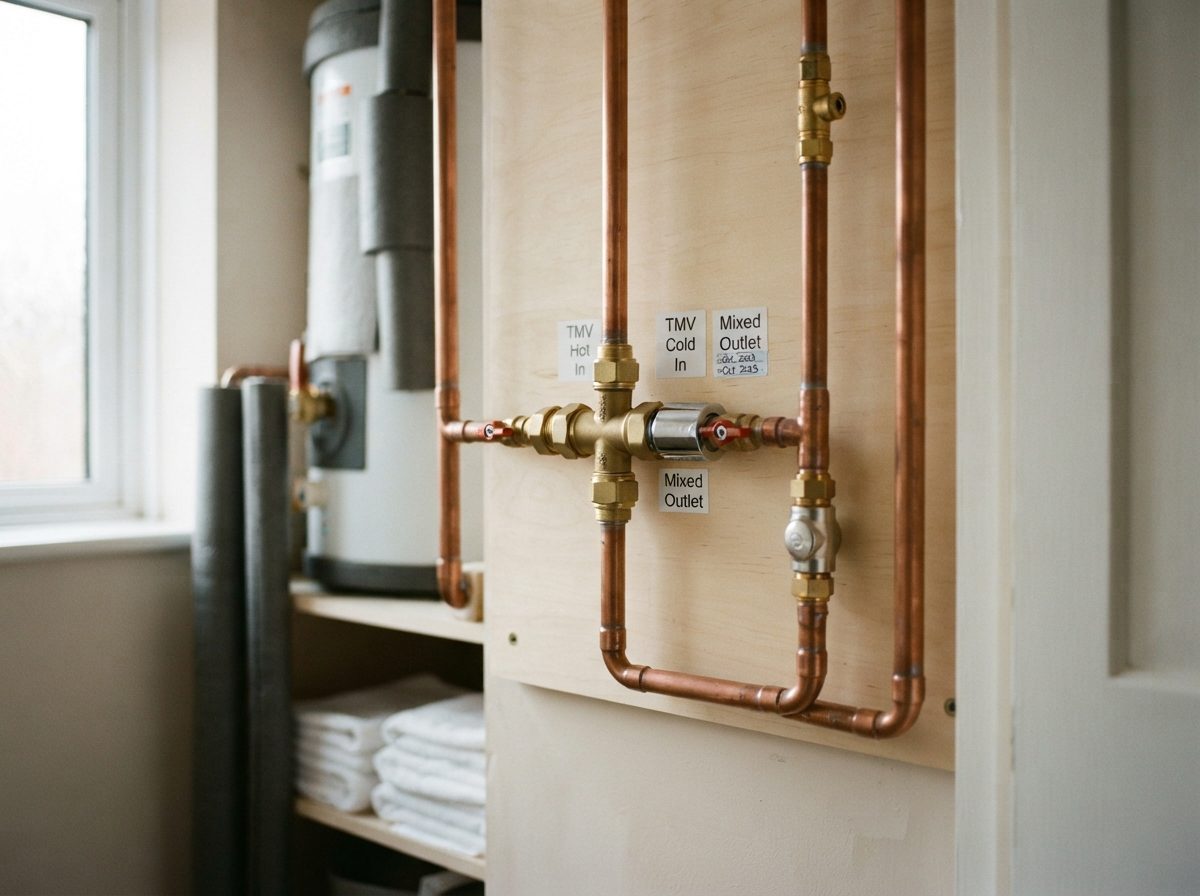
What applies to TMVs in England
In England the main reference for healthcare water systems is HTM 04-01, published for the NHS. Its D 08 supplement sets out how a TMV3 valve should perform, the maximum mixed temperatures at each kind of outlet and how in-service tests are carried out. Care homes, clinics and other settings outside the NHS often borrow the same document because it is the most detailed public guidance there is. Where care is regulated, the Care Quality Commission (CQC) looks at whether a provider manages scalding risk from hot water, and TMV records are one of the things an inspector may ask to see.
New homes in England, and homes formed by a change of use, fall under Part G of the Building Regulations, which limits hot water delivered to a bath to 48°C. A TMV or a thermostatic bath valve is the usual way to meet it. Any fitting connected to the mains must meet the Water Supply (Water Fittings) Regulations 1999, which cover England and Wales and deal with backflow, check valves and correct installation. In rented housing the Housing Health and Safety Rating System (HHSRS) treats scalding as a hazard to be assessed, and Awaab's Law now puts time limits on social landlords in England for dealing with certain hazards once they are reported.
Water quality varies a great deal across England. London, the South East, the East of England and much of the Midlands have hard water, which builds scale in strainers and thermostatic cartridges quickly. The North West, much of the North East and Devon and Cornwall have softer supplies, where scale is slower but debris and sediment still collect at the strainers. The interval between services in England is set by the site's risk assessment and by how far each valve drifts between visits, not by a fixed national rule.
Points English TMV owners raise
-
HTM 04-01 is guidance, not statute
HTM 04-01 is not law, but in England it is the benchmark a regulator or an insurer will compare your arrangements against. Departing from it is possible if your risk assessment explains why.
-
CQC inspections ask for evidence
A registered care service in England is expected to show how hot water risks are controlled. Valve-by-valve readings, fail-safe results and a dated logbook are what usually answer that question.
-
Part G only covers new work
The 48°C bath limit applies to new homes and change-of-use conversions in England. Older homes are not caught retrospectively, though a landlord's HHSRS duties still apply.
-
Hardness depends on the region
A valve in Essex and one in Cumbria can need quite different strainer and cartridge attention. Your water company's published hardness figure is a good starting point for setting intervals.
English regions we cover
Every region of England is covered through the partner engineer network. Each region has its own page with its water and building notes.
- LondonHard to very hard water, mostly from Thames Water, with a dense mix of flats, offices, hotels and care settings.
- South EastLargely hard, chalk-fed water that scales strainers fast; many schools, care homes and coastal hotels.
- South WestHard water around Bristol and Bath, much softer in Devon and Cornwall; holiday lets and rural care settings.
- East of EnglandSome of the hardest water in England, with market towns, new-build estates and agricultural communities.
- East MidlandsMostly hard water, with Nottingham and Leicester at the centre and a large stock of terraced housing.
- West MidlandsMixed hardness: Birmingham's Elan Valley supply is soft, while much of the surrounding area is harder.
- Yorkshire and the HumberGenerally softer water in the west, harder towards the east coast; Leeds and Sheffield are the main cities.
- North WestSoft water from upland reservoirs in most areas, covering Manchester, Liverpool and Cumbria.
- North EastMuch of the region has soft to moderately soft water; Newcastle, Sunderland, Durham and Teesside.
TMV services English sites ask for
- TMV testing to HTM 04-01In-service temperature and fail-safe tests recorded the way English healthcare guidance describes.
- Care homesValve servicing and records that support what CQC inspectors in England look for.
- Social housingTMV work for English housing providers managing HHSRS hazards and repair reporting.
- TMV installationNew valves for baths in England where Part G's 48°C limit applies.
- Strainer cleaningMost useful in the hard water regions of southern and eastern England.
TMV questions from England
Does every site in England have to follow HTM 04-01?
No. It is written for NHS healthcare buildings, but many care homes, schools and housing providers in England use its test methods because nothing else is as detailed.
Does CQC say how often TMVs must be serviced?
CQC does not set a frequency. It expects a registered provider to assess the risk and to show that the controls it chose are carried out and recorded.
Is the Part G limit the same across England?
Yes. The 48°C limit on hot water to baths in new homes and change-of-use homes applies throughout England.
What does Awaab's Law mean for TMVs?
It sets time limits for social landlords in England to investigate and deal with certain reported hazards. Keep your housing team's own policy as the guide to how it applies to hot water.
Who checks water fittings in England?
Your local water company enforces the Water Supply (Water Fittings) Regulations 1999, and may inspect new installations or ask to be notified of certain work.
TMV work anywhere in England
Tell us where the site is, how many valves there are and what the last records show. Alex matches the job to a partner engineer in that region and the price is agreed before work starts. Use the form and press Send an enquiry.
Send an enquiry